


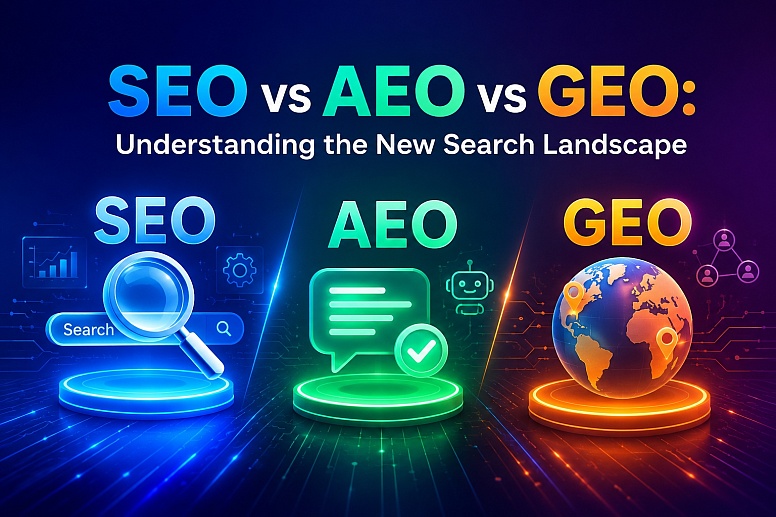
SEO vs AEO vs GEO: Understanding the New Search Landscape
Search is evolving faster than ever.
For years, Search Engine Optimisation (SEO) was the primary way businesses improved online visibility. Today, users increasingly rely on AI-powered tools such as ChatGPT, Google AI Overviews, Gemini, Perplexity, and Claude to find information, compare products, and discover local businesses.
As a result, new optimisation strategies have emerged, including Answer Engine Optimisation (AEO) and Generative Engine Optimisation (GEO).
But what do these terms actually mean, and how do they work together?
Let's take a look at how SEO, AEO, GEO, and other important search visibility disciplines are shaping the future of digital marketing.
What Is SEO?
SEO (Search Engine Optimisation) is the practice of improving a website's visibility in traditional search engine results.
The goal is simple: rank higher for relevant keywords and attract organic traffic.
SEO typically includes:
- Keyword research
- Technical SEO
- On-page optimisation
- Link building
- Content marketing
- User experience improvements
For example, if someone searches:
"best local SEO agency UK"
SEO aims to help your website appear prominently in Google's search results.
What Is AEO?
AEO (Answer Engine Optimisation) focuses on helping content appear within AI-generated answers.
Rather than competing solely for rankings, AEO aims to position your content as a trusted source that answer engines use when generating responses.
AEO platforms include:
- ChatGPT
- Google AI Overviews
- Gemini
- Perplexity
- Microsoft Copilot
- Claude
When a user asks:
"What is the best CRM for small businesses?"
An answer engine may generate a summary using information from multiple websites. AEO helps your content become one of those sources.
What Is GEO?
GEO (Generative Engine Optimisation) is the process of optimising content, brand authority, and digital signals to increase visibility within AI-generated search experiences.
While AEO often focuses on individual answers, GEO takes a broader view of how AI models discover, understand, and reference brands. Businesses can use the best AI visibility trackers to monitor how often their brand appears across AI platforms.
GEO strategies include:
- Building topical authority
- Digital PR
- Brand mentions
- Entity optimisation
- Structured data
- Expert-led content
- Knowledge graph visibility
Think of GEO as the evolution of SEO for AI-powered search ecosystems.
SEO vs AEO vs GEO
| Factor | SEO | AEO | GEO |
|---|---|---|---|
| Primary Goal | Rank webpages | Appear in answers | Increase AI visibility |
| Focus | Search engines | Answer engines | Generative AI platforms |
| Success Metric | Rankings and traffic | Citations and mentions | Brand presence across AI systems |
| Target | Keywords | Questions | Topics, entities, and authority |
| Platforms | Google, Bing | ChatGPT, Gemini, Perplexity | AI ecosystems broadly |
Rather than competing strategies, SEO, AEO, and GEO work best together.
What Is Local SEO?
Local SEO focuses on improving visibility for location-based searches.
Examples include:
- Plumber near me
- Accountant in Manchester
- Local SEO agency London
Local SEO typically involves:
- Google Business Profile optimisation
- Reviews management
- Local citations
- Location pages
- Local link building
Strong local SEO is increasingly important for AI-generated local recommendations.
What Is Local AEO?
Local AEO extends traditional local SEO into AI-powered search.
Instead of ranking only in Google Maps, businesses aim to appear when users ask AI tools questions such as:
- Who is the best solicitor in Leeds?
- Which local SEO agency should I hire?
- What are the top-rated restaurants near me?
AI systems often rely on signals from local SEO, making both disciplines closely connected.
What Is Entity SEO?
Entity SEO focuses on helping search engines understand who or what your business represents.
Google increasingly relies on entities rather than keywords alone.
Examples of entities include:
- Brands
- People
- Companies
- Locations
- Products
- Organisations
Entity optimisation helps search engines and AI models build confidence in your expertise and authority.
What Is E-E-A-T?
E-E-A-T stands for:
- Experience
- Expertise
- Authoritativeness
- Trustworthiness
Although not a ranking factor itself, E-E-A-T heavily influences how Google and AI systems evaluate content quality.
Strong E-E-A-T signals include:
- Expert authors
- Original insights
- Real-world experience
- Industry credentials
- Trustworthy sources
These signals are becoming increasingly important in both SEO and GEO.
What Is Digital PR?
Digital PR helps businesses earn mentions, links, and authority across the web.
Benefits include:
- Brand awareness
- Backlinks
- Entity recognition
- AI visibility
- Improved trust signals
Many GEO strategies depend heavily on strong digital PR campaigns because AI systems often reference brands that are discussed across authoritative websites.
What Does the Future Look Like?
Search is no longer limited to ten blue links.
Users now interact with:
- Search engines
- AI answer engines
- Generative AI assistants
- Voice assistants
- Local discovery platforms
As a result, businesses need a broader visibility strategy.
The future belongs to brands that combine:
- SEO
- Local SEO
- AEO
- GEO
- Entity optimisation
- Digital PR
- E-E-A-T-driven content
Together, these disciplines help businesses appear wherever users search, ask questions, or seek recommendations.
Final Thoughts
SEO remains the foundation of online visibility, but it is no longer the whole picture.
As AI-powered search continues to grow, businesses must think beyond rankings and focus on becoming trusted sources of information.
SEO helps people find your website.
AEO helps AI systems cite your content.
GEO helps AI platforms recognise and recommend your brand.
The businesses that embrace all three disciplines will be best positioned to succeed in the next generation of search.
LEAVE A COMMENT







0.2334