


The Best Ecommerce Mobile App Builders to Grow Your Brand in 2026
If you're an ecommerce brand, looking for a reliable, profitable revenue channel, the question isn’t “should we have an app”. It's how to build one.
The good news: there's never been more choice. The harder news: with more choice comes more chance that you’ll make the wrong choice.
A mobile app should be one of the core channels for your brand. So getting it right is crucial. You need to choose a platform that works seamlessly with the rest of your setup and maximizes the output while minimizing the lift and overhead of having an app. Some brands even prefer going custom by hiring an Android App Development Company for full flexibility.
Here's the full guide on choosing the right tool to build your store’s mobile app.
Why Your Ecommerce Brand Needs A Mobile App
If you’re not yet sold on the idea that you need a mobile app, let’s convince you.
Here are the top reasons why just about every brand should have its own app.
Apps put your brand on the home screen.
A mobile app gives you something incredibly powerful: a permanent place on the customer's most-used device. Your icon sits between their messages app and their banking app, visible every time they unlock their phone. No URL to remember, no Google search to navigate, no ad to click. One tap and they're in your store.
That kind of presence compounds. A customer who'd visit your site once a month might open your app three times a week, because opening an app is one gesture, and your brand is already in front of them.
Stronger retention and engagement metrics
Apps drive big lifts in the metrics that matter most long-term. Repeat purchase rate. Average order value. Lifetime value.
According to MobiLoud's Ecommerce Mobile App Benchmark Report, app users generate 2.8 to 5x higher LTV than mobile web visitors, 10-50% higher AOV, and 60% of first-time app buyers come back for a second purchase.
These lifts come from the ease and convenience of shopping in an app, which makes customers come back more often and shop longer in each session.
Push notifications that cut through the noise.
There’s so much noise in every channel these days, from email to SMS to social media.
But mobile apps unlock a powerful channel, with far less competition, and a direct line to your best customers: push notifications.
Native push notifications land on the customer’s lock screen, with almost guaranteed visibility. They’re the most powerful tool you can have for promos, product launches, abandoned cart notifications, and almost every other kind of brand-to-customer communication.
You own the channel
Every other customer-facing channel an ecommerce brand uses is rented.
Google, Meta, and TikTok all run on volatile algorithms or require you to pay to show up. Email visibility can get throttled. SMS providers can cut you off.
A mobile app is the one surface where nobody sits between you and your customer. You own the install, you own the notification permission, you own the data, and you own the messaging. In a market where every other channel is getting more expensive and less predictable, ownership is the most valuable thing a brand can build.
The 7 Best Ecommerce Mobile App Builders In 2026
Without anything further, here are seven ways for you to launch your own mobile app, quickly and easily: with options that suit stores on a range of platforms, operating at multiple scales, from SMBs to enterprise brands.
1. MobiLoud: best mobile app builder for mid-market and enterprise brands (on any platform)
Best for: Brands doing $10M+ in annual ecommerce revenue that want a native iOS and Android app built on their existing web stack, with the whole process managed for them.
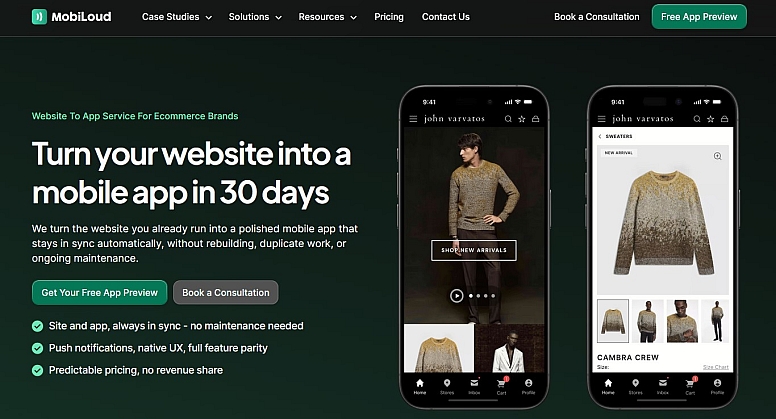
MobiLoud is an ecommerce mobile app builder that turns your existing website into a custom, full-featured mobile app.
It’s a fully managed service. MobiLoud’s team handles the entire process for you, from build to testing to app store submission and ongoing maintenance.
The best feature about MobiLoud is that it works with any ecommerce platform and every feature on your site. MobiLoud works with brands on Magento, BigCommerce, Shopify, Salesforce Commerce Cloud, WooCommerce, and more. And everything that works on your site will work in the app. There are no templates, no integration limits, just your existing website converted into a professional mobile app.
It’s a higher cost than some simpler DIY app builders, but that reflects the level of service provided, as well as MobiLoud’s ideal customer: high-end stores who need a high-end app.
Key features:
- Native iOS and Android apps built in Swift, Kotlin, and Java
- Works on any web stack: Shopify, Shopify Plus, BigCommerce, Magento, Salesforce Commerce Cloud, WooCommerce, Shopware, headless, custom
- Full feature parity: everything from your website works in your app, guaranteed
- Unlimited native push notifications, including automated flows like cart abandonment
- Deep linking, smart app banners, App Store, and Google Play submission
- ~30 days from kickoff to live on both app stores
- Fully managed: ongoing maintenance, OS updates, store policy changes, all handled
Price range: Premium price point: custom quotes given based on the store’s requirements (typically $1,000+ per month).
2. Tapcart: best Shopify-native builder for SMBs/mid-market brands
Best for: Growing Shopify brands that want a drag-and-drop builder that integrates with the Shopify backend.
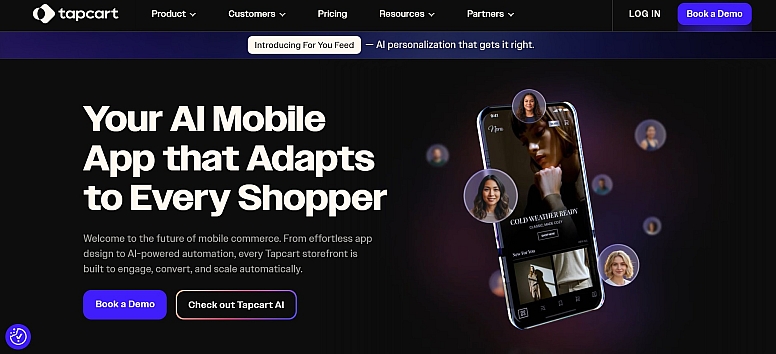
Tapcart is one of the most well-known Shopify mobile app builders. It gives non-technical teams a way to build, configure, and launch their own apps, all managed through a convenient dashboard.
The app comes with almost everything you need: native push notifications, AI personalization, and integrations with many popular Shopify apps.
It’s only for Shopify - stores on Magento, WooCommerce, BigCommerce, etc. will need to find a different option. But if you’re selling on Shopify and want an option you can manage in-house, Tapcart is a solid choice.
Key features:
- Drag-and-drop builder with a deep template library
- Native Shopify integration (catalog, checkout, customer data)
- Push notification campaigns and audience segmentation
- App-exclusive product, block, and discount features
- Strong merchandising controls for non-technical teams
Pricing: Starts at $250 per month, rising depending on the level of features you need.
3. OneMobile: best AI-driven Shopify app builder
Best for: Shopify brands that want a no-code builder with AI baked in.
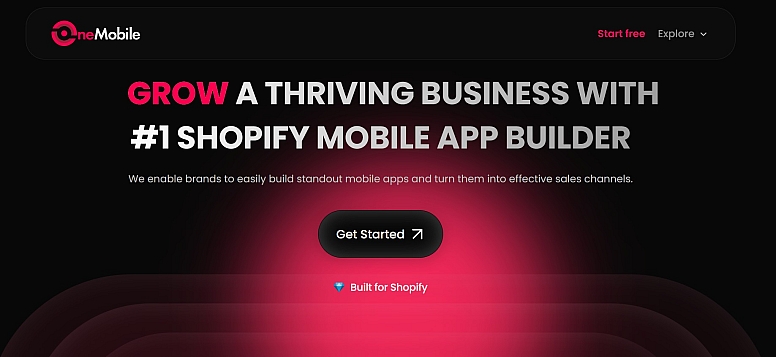
OneMobile is a newer entrant in the Shopify space and goes strong into the AI angle.
Their builder uses a drag-and-drop "tile system" for app layout, but the part that sets them apart is the AI layer sitting on top: OneMagic AI personalizes push notifications based on in-app behavior, an AI Sales Assistant supports conversion flows, and an AI Content Assistant handles things like app store copy.
All these features can help brands with small teams optimize things like push timing, A/B-testing campaigns, and writing fresh in-app content, freeing up their time to handle other areas of the business.
Key features:
- No-code drag-and-drop "tile system" with pre-built themes and blocks
- OneMagic AI for personalized push notifications based on in-app behavior
- AI Sales Assistant and AI Content Assistant
- Automated push flows (cart abandonment, back-in-stock, win-back)
- “Free” tier available that lets you build and preview your app (need a paid plan to publish)
Pricing: Low entry-level tier, starting at $99 per month (with 2.9% success fees on top).
4. Shopney: best entry-level builder for small Shopify stores
Best for: Small-to-medium Shopify stores that want a clean native app at a low entry point.
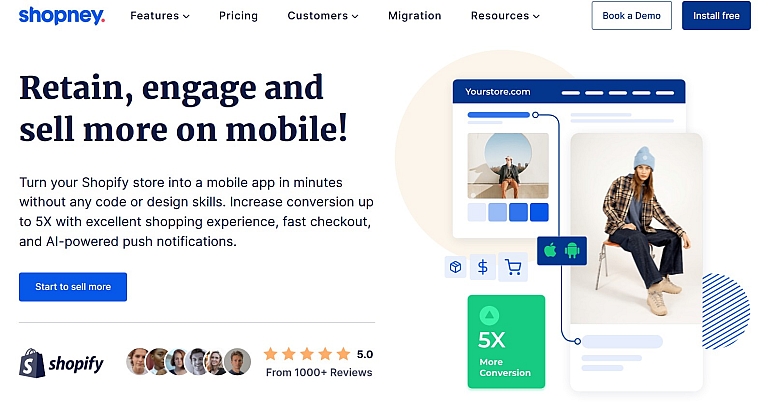
Shopney is a dependable template-based Shopify mobile app builder, with an affordable entry tier.
It’s simple and fast to launch, and comes well-reviewed, with over 700 reviews on the Shopify App Store. It delivers everything you need in a mobile app and offers a range of features on higher tiers that fit brands with more advanced needs, like multi-store support, barcode scanners, and live selling.
Key features:
- Library of pre-built themes and screens
- Drag-and-drop merchandising controls
- Cart abandonment and basic push campaigns
- Native chat support
Pricing: Plans start from $149/month, scaling up through mid-tier and enterprise plans into four figures per month.
5. AppMySite: best budget DIY builder for Shopify and WooCommerce
Best for: Smaller stores on Shopify or WooCommerce that want a low-cost DIY app and don't need deep customization.
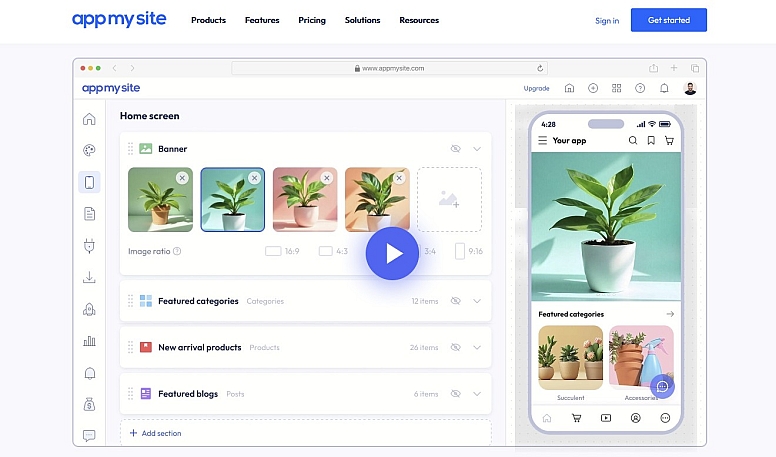
AppMySite earns a spot on this list for one specific reason: it's one of the few affordable builders that actually supports WooCommerce. Most of the cheap end of the market is Shopify-only. AppMySite isn't.
It's template-driven, designed for self-serve setup, and aimed at the long tail of stores that want an app on a small budget. It's not going to win design awards, but if you're on WooCommerce, your budget is tight, and you just want a working iOS and Android app, AppMySite is the path of least resistance.
Key features:
- Supports both Shopify and WooCommerce
- Drag-and-drop configurator with theme options
- Basic push notifications
- Entry pricing under $50/month, with a free Preview plan to try the platform
Pricing: Low entry-level pricing, plus the option for a one-time lifetime payment.
6. JMango360: best for non-Shopify stores, looking for a template-driven app
Best for: Stores on Magento, BigCommerce, Salesforce Commerce Cloud, and those wanting an API/template-driven app builder.
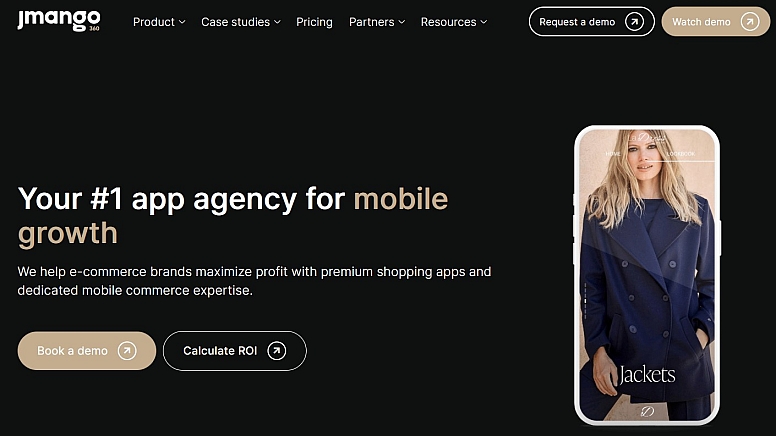
If you're not on Shopify, the Shopify-native app builders like Tapcart and Shopney aren't an option. JMango360 offers an answer to that problem. It works with multiple platforms, integrating with multiple different APIs (not just Shopify, like most app builders).
They support Magento (Adobe Commerce), BigCommerce, WooCommerce, and Salesforce Commerce Cloud, with a managed-service component for brands that need more than self-serve.
The product isn't as specialized on any single platform as a Shopify-only tool is on Shopify, but for a brand that runs across multiple platforms or sits in the non-Shopify mid-market, having a single vendor is often worth the trade.
Key features:
- Genuine multi-platform support: Magento, BigCommerce, WooCommerce, Salesforce
- Native iOS and Android apps
- Push notifications and basic automation
- Managed-service tier for enterprise customers
- Long track record in the space
Pricing: Custom-quoted by use case. Pricing is typically on the higher end, often $1,000+ per month.
7. Buildfire: best for brands building an app-only experience
Best for: Brands looking for an app-first approach.
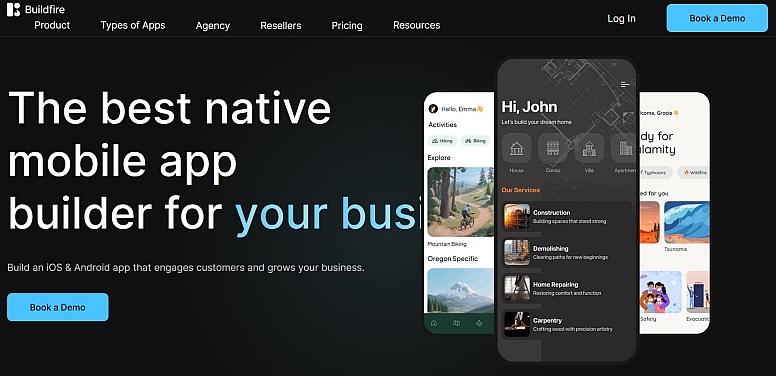
Buildfire is a different category of tool. Unlike other ecommerce mobile app builders, which are built to turn your website into an app, Buildfire is built to let you create a mobile app from scratch.
You work from a blank canvas and use the platform’s pre-built templates and plugins to compile your app’s UI and functionality from the ground up.
You can connect it with Shopify, but the platform isn’t ideal if you just want an extension of your store. It’s better suited for building a standalone ecommerce app, like a restaurant app or an app for a small retail store.
Key features:
- No-code app builder with a plugin marketplace
- Custom plugin SDK for development beyond the marketplace
- Done-for-you build option in addition to self-serve
- Not ecommerce-only - broad app category coverage
Pricing: Paid plans start from a few hundred dollars per month, with custom development services available by request.
How To Choose The Right Ecommerce Mobile App Builder
The seven tools above are all real options for some brand somewhere. The question is which one is the best fit for your business.
You’ll want to narrow down the list first by your platform.
Many app builders only work with ecommerce brands on a specific platform (often Shopify). If your store is on a different platform, that rules out a number of options.
Then you’ll want to see which mobile app builders support the kind of features you need in an app, and the features and integrations that work on your website.
Finally, look at things like pricing, support, and long-term maintenance required. Mobile apps require constant work, and you need to know that your app will stay up to date and functional as platforms update and you add new features to your store.
For mid-market and enterprise brands, MobiLoud is the best option. It’s the best way to get a custom app that fully integrates with your website, no matter what platform or features you run.
For Shopify-native options, look at Tapcart or Shopney, or AppMySite if you’re on Shopify or WooCommerce and need a low-cost option.
Turn Your Ecommerce Store Into An App With These Mobile App Builders
The hard part of launching a mobile app isn’t so hard anymore.
It used to be a huge project, taking months and months of development time. Now, you can use an ecommerce mobile app builder that lets you go live with a professional app in less than a month.
The hard part now? Building a product and a brand that customers love, and want to buy from again and again.
Do that, and give these customers a mobile app, and you’ll have a wildly successful ecommerce business.
LEAVE A COMMENT







0.1533